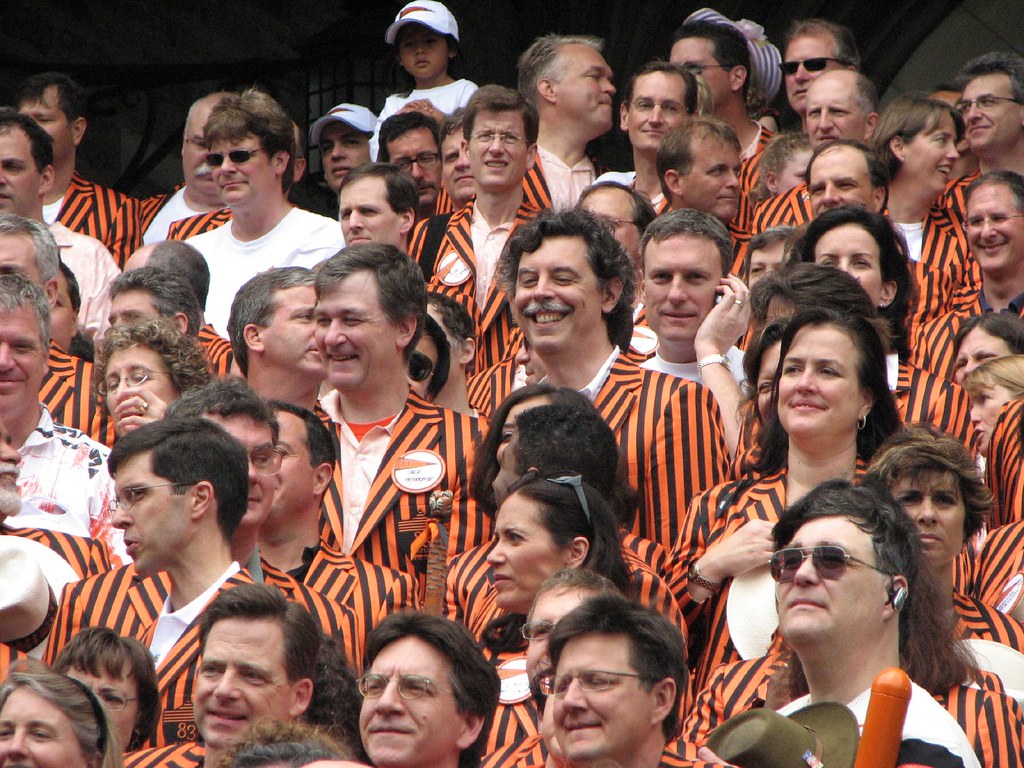
Eric Suh, a molecular biology graduate student and Harvard alum, reports:
I couldn't believe it; a five-minute drive out from campus, and there were just small houses! Farmland! Princeton was tiny! Harvard, where I went to college, was just across the river from Boston. Everything there felt big, from the number of students to the personalities. When I got to Princeton, I went through a bit of culture shock at how small it felt. At the same time, though, I quickly felt a connection to the students and faculty. The community at Princeton was really quite remarkable.
If there were any analogy to really describe how different Princeton and Harvard felt to me, the closest one might be the contrast between a giant research university and a liberal arts college. Harvard is an academic behemoth, with 20,000 undergraduate, graduate and professional students and nearly 12,000 affiliated faculty members. Nowhere else in the world can you tap the kinds of incredible opportunities that Harvard offers: the huge affiliated hospital system and its many labs waiting for students to join; the many museums and research archives in Boston; the numerous faculty studying a greater breadth of topics than can be covered at smaller universities; and especially the sprawling Harvard alumni network that packs the top ranks of academia, the Fortune 500 and governments and social organizations across the world. It definitely felt like, whatever I wanted to do, Harvard could help me get there.
On the other hand, I sometimes felt bewildered or lost in the giant milieu. Though Harvard had recently started to revamp its hit-or-miss advising system, I often wondered how much Harvard's president could pay attention to the needs of the small portion of campus that comprised the undergraduates. It definitely seemed like the happiest folks at Harvard were those that knew what they wanted and what they liked, so that they could wring what they wanted out of their Harvard experience.
Princeton's comparatively miniscule 7,000 students and 850 faculty make a smaller community that definitely feels more focused and connected. Even as it fosters world-renowned research and graduate programs, Princeton's focus and commitment to its undergraduate students and their education is quite palpable in every aspect of campus life. Via the senior thesis requirement, almost every student gets to know and interact with a professor outside the classroom, something that pays off long after college. It didn't surprise me that even without the many professional schools that Harvard has, Princeton has a much larger endowment per capita than Harvard, and the scale and turnout to Princeton's undergraduate alumni Reunions makes Harvard's pale in comparison. Princeton has a community that is a unique asset to the students that go there.
Despite these differences, Princeton and Harvard are quite similar in many ways. Both Ivy League universities are filled with students who dominated high school academics, brilliant scientists, performers, writers and athletes. Both have old traditions and anachronisms that refuse to die. Neither have official Greek systems, though Princeton has "eating clubs," venues of varying selectivity for students to eat together and socialize, and Harvard has "final clubs," all of which are selective. Of course, any college that gathers large collections of ambitious, intelligent students will have hundreds of different organizations founded for different causes and interests; some will be ancient institutions, while others will be one-off projects that vanish once the dominant personalities leave.
In the end, the main differences I perceive between the schools are location and size; in other respects, both are equally excellent schools of high prestige and academic rigor. If I were to choose today between Harvard and Princeton, it would boil down to deciding between big-city opportunities versus small-town community.
Monday, January 18, 2010
Orange and Apples: Harvard


Sunday, January 17, 2010
Tracing the Quake
For those interested in learning more about the earthquake that devastated Haiti, geosciences professor Jeroen Tromp has developed simulations of the seismic waves it produced. Tromp is also a professor of applied and computational mathematics, and his research focuses on theoretical and computational seismology.
The simulation, which represents the waves as ripples along the Earth's surface, can be found at PICSciE. It was also featured here, where you can find out more about how the simulations were developed.
Orange and Apples: Harvard
What is Princeton really like? How does it compare to other options you might be considering for college if you are still choosing the site for your undergraduate experience? Or maybe you are already at Princeton and you want to know what you would be doing right now if you didn't have exams this week?
Given that Princeton does not accept transfers, there are few people who attend Princeton and another institution as an undergrad, so we have called on undergraduates and graduate students to compare their two schools. Some attended Princeton and then moved onto other institutions, while others came to Princeton for graduate school.
Today we're going to start with history graduate students Paul Davis and Sarah Milov, who both attended Harvard.
So here you are, a high school senior faced with the biggest decision of your life: Harvard or Princeton? But whom can you talk to about this problem? Your best friend has only gotten into Duke, and your parents are pushing their alma maters. So you’ve done what any gunner in your position would do: You’ve sought the wisdom of The (online) Daily Princetonian. Though if you’re basing your decision on the superiority of on-campus newspaper, you already have your check in the mail to zip code 02138.
Harvard vs. Princeton: It’s a matchup as legendary as Pacino vs. De Niro and even harder to adjudicate. After all, how many have actually attended both universities as undergrads? JFK did, but he's unavailable to render a verdict.
Still, this dispute must be resolved. Ordinarily, prefrosh can base their decisions on the infallible U.S. News rankings, but it appears that the two schools are currently tied. Another lodestar must be sought.
And thus, as Harvard alumni and Princeton grad students, we will do our best to offer guidance, aware that our impressions of undergraduate life at the latter institution have been glimpsed through a glass darkly (and sketchily). Below are a few categories and our judgments.
Prime Location: Harvard. Cambridge is pulsating and of ample size. Princeton is a tiny yuppie hamlet, as insular and incestuous as the village in M. Night Shyamalan’s eponymous film. Given that the world beyond is Route 1, we suppose that quarantine is probably prudent.
Prime Weather: Neither. If this matters, go to Stanford.
Convenient Urban Excursions: Harvard, to Boston. The T shuts down early, but it’s fast, cheap and convenient. Princeton touts its nearness to New York, but do you really want to spend two-and-a-half hours on NJ Transit trains? Alongside New Jersey residents? Only to arrive back in bucolic Princeton Junction after the Dinky has stopped running, necessitating a $15 cab ride on top of steep train tickets and Metro fares? Unless you know someone in the city at whose apartment you can crash, you will not head up there with any regularity. And let’s not even discuss the absurd inconveniences involved in getting to Philly by public transportation: it just isn’t worth it.
Convenient Rural Excursions: Princeton. New Jersey isn’t just turnpikes and strip malls and dusty beach roads lined with skeleton frames of burned-out Chevrolets: The area around Princeton is actually quite lovely. Get a bike, and go crazy.
Best On-Campus Food: Princeton, by a hairnet. Some of its dining halls and eating clubs are mediocre, but we have to give them the edge on account of Forbes’ chocolate fountain and the generous selection of hard-serve ice cream.
Best Off-Campus Restaurants: Harvard, by a mile. We’ve eaten at every restaurant in Princeton — save the Bulgarian place beneath La Jolie — and nothing compares to Rialto, Harvest, Cambridge 1, Tamarind Bay, 9 Tastes, Finale or the greasy late-night drunk food of Felipe’s, Noch’s and the Kong. Add in gems like Dali and Punjabi Dhaba in Inman and the disparity is even greater. In every food category and price range, the establishments of Harvard Square are either equal or superior.
Best Haitian-Owned Pastry Shop: OK, not every category: This has to go to Princeton, home of The Little Chef. The other close calls are ice cream, hoagies and full-service convenience stores, but in general it seems like there’s an inverse relationship between proximity to campus and quality of food. It’s difficult to comprehend how a just God would allow the respectable cuisine of Conte’s and Da’s (winner of a separate category: “Best Thai Restaurant in a YMCA”) to be pushed aside by abominations like Sotto and Thai Village, but the judgments of the Lord are true and righteous altogether. P.S. For the record, PJ’s pancakes are terrible.
Safer Campus: Princeton. Yes, there’s the Serial Flasher, but during our freshman and sophomore years alone we had the Bicycle Groper, the Serial Whisperer and the Alleged Masturbator. Princeton has numerous false gunman warnings, but Harvard has real gunmen. It’s practically New Haven. Which reminds us...
Most Storied Rivalry: Harvard. With Yale. What's Princeton's rival again? Penn State?
Best Administrative Paternalism: Princeton, which shows it has its priorities straight by keeping Dillon Gymnasium open later than Firestone Library, while Harvard lets strivers burn themselves out at a 24-hour Lamont.
Superior Academic Experience: Probably Princeton, where professors advise all senior theses. If you go to Harvard, most of your education will be administered by cold, angry, overworked graduate students; conversely, as this article indicates, Princeton grad students are good-humored and have plenty of time on their hands. But what kind of nerd picks their college based on academics?
Superior Nightlife: It depends. If you like the eating club scene, Princeton’s great; if not, you’re out of luck. Harvard is more of a mix with final clubs, affordable bars, House events and crowded room parties. But let’s be honest: Neither school is Arizona State.
Most Accomplished Alumni: Harvard.
Most Self-Satisfied Alumni: Princeton. They donate more money to their alma mater and come back each spring, dressed identically, to relive their idyllic college years. In short, they seem happier than Harvard grads, but also more cultish.
FINAL VERDICT: Honestly, it doesn’t really matter: You’ll probably end up a smug douchebag either way.
Friday, January 15, 2010
Be Valuable
USA Today and Princeton Review think the University is valuable, but not the most valuable private college in the nation. They have ranked public and private colleges around the United States based on the value the schools provide for their cost. Princeton was ranked fourth, down from third last year.
The rankings use the financial aid rate, the cost of the school when aid is taken into account, and the academics of the school, based on admission statistics and opinions given by students. They considered 650 public and private colleges.
This comes shortly after a report finding that Princeton students graduate with the least debt of all students at New Jersey colleges.
Private Colleges
Public Colleges
Sunday, January 10, 2010
Princeton in Primetime
Our campus doesn't make it on TV often (unless its a back-to-back showing of 'Transformers 2' and "A Beautiful Mind"), but WABC sent a news team to cover the campus debate over arming Public Safety.
Friday, January 8, 2010
Women's basketball team begins its Ivy League season

Off to a 12-2 start, Princeton posted a series of impressive victories over the winter break. The winning streak will certainly give the team momentum heading into its first Ancient Eight contest.
The Return of 'Tax Fairness'
During the last Borough Council election, the idea that the University was failing to pay a fair share in taxes to the Borough was a central part of each of the Borough Council candidates' platforms. The tax-exempt status of much of Princeton's campus is an issue for the Borough, Township and West Windsor, all of which have suffered in the recent economic downturn. Therefore, the Princeton Township Council is planning to introduce a resolution at its upcoming meeting to call for an increased dialogue on the idea of a further voluntary contribution from the University to the Township, according to a report in The Princeton Packet.
The Princeton Citizens for Tax Fairness, the bipartisan group calling for the increased donation, argues that the University uses services but does not adequately pay for them. According to a founding member and Township councilwoman, if Princeton were not a nonprofit, it would have paid $42 million in taxes in 2008.
On the other hand, the University argues that its economic impact stretches beyond taxes and that it does already offer voluntary contributions. University contributions amounted to $8.9 million to the Borough and Township, as well as $3.5 million in voluntary taxes.
Will this new resolution make a difference to the amount of Princeton's voluntary contribution? Do you think that it should be increased?
Wednesday, January 6, 2010
Procter Blotter: December 2009
Crimes reported to or caught by the Department of Public Safety during December 2009.
View December 2009 Crime Map in a larger map
Tuesday, January 5, 2010
Undocumented Students
Last week The New York Times devoted an article in their Education Life section to one Princeton alum's experience on campus. No, he hadn't been nominated to the Supreme Court. Rather, he did something completely alien to most Princetonian's experience. He attend the school while an illegal immigrant.
Harold Fernandez '89, who was originally from Colombia and traveled to the US on a wooden boat, attended Princeton with a fake Social Security number and green card. The story explores this future Molecular Biology major's journey through the University.The article is well worth reading for an interesting look into how the University handled the discovery that Fernandez was breaking both the federal law and the honor code.
The article notes:
"First, he had broken Princeton’s honor code, which essentially affirms that students will not cheat or lie. Moreover, he had improperly received government money intended for American citizens or permanent residents.“Just as I was feeling crushed by the gravity of these issues,” he remembers, “she went on to say: ‘But, Harold, both problems have solutions.’ "
Despite the unlikeliness of Fernandez's story, he is not the only Princeton student to have attended Princeton while an illegal immigrant. The 2006 Latin salutatorian, Dan-el Padilla '06, announced that he was an illegal immigrant in a story in the Wall Street Journal. He would later receive a H1-B visa to return to the US to work on a project with his former thesis adviser.
Sunday, January 3, 2010
Professor, that's the bell
As you start to head back to campus for reading period, remember: Exams are bad, but it could be worse. Think back to an interminable 50-minute lecture last semester. Now count yourself lucky that your professor wasn’t Errol Tapiwa Muzawazi. Muzawazi, a 25-year-old law student, set a new world record on Dec. 9 with a lecture lasting 121 straight hours, one hour longer than the previous record. The effort was a response by 50 young people in 16 countries to Millennium Development Goal 8 (Develop a global partnership for development), one of a series of international development objectives crafted by a U.N. initiative for completion in 2015.
To symbolize the global nature of the lecture, Muzawazi had six costume changes during the event and delivered his opening remarks in six languages. Presided over by Professor Karol Musiol, the rector of Jagiellonian University in Krakow, Poland, the talk was broadcast live online and coordinated with a concurrent online chat which allowed viewers to submit questions to the lecturer. So the next time you’re struggling to stay awake during your Friday morning math class, just think how lucky you are that your class isn’t 145 times as long.


 Posts
Posts