
Meg Whitman '77, a candidate for the Californian Republican primary, was accused of trying to bully the competition earlier this week. Steve Poizner, who is also a Republican candidate for governor, explained that a member of Whitman's campaign team sent him an e-mail strongly urging him to run for senator in 2012.
Poizner has suggested that the contents of the e-mail constitute an illegal threat and has sent complaints to the F.B.I. and the United States Attorney's Office. The e-mail states that, if Poizner chose to run for the Senate in 2012, Whitman could ensure total party support.
The e-mail also notes that the competition between Whitman and Poizner in the primary would be an unnecessary waste of resources. The e-mail likely was not criminal, especially because it offers support and not money.
A California Field poll in January found that Whitman is leading with 45 percent support to Poizner's 17 percent.
Whitman graduated from the University with an AB in economics in 1977. In 2002, she donated $30 million to the University to build the eponymous residential college. Whitman served as president and CEO of eBay from 1998 until 2008, when she resigned to pursue a career in politics.
The primary election will be on June 8, and the governor will be elected on November 2.
Thursday, February 4, 2010
Whitman '77 accused of bullying competition


Wednesday, February 3, 2010
Diggin' In The Mudd: Princeton Reunions Through the Ages


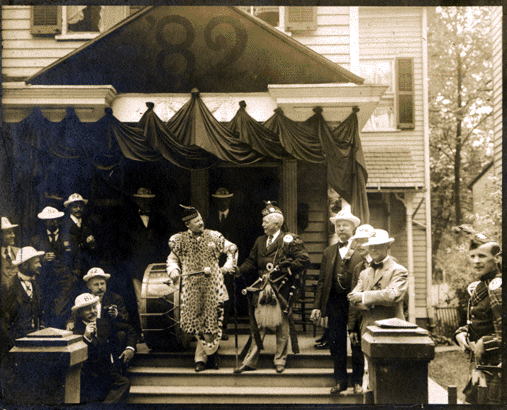
It starts off with the class of 1882 where viewers can see this lovely photo of preparation for the P-Rade involving a large drum and a leopard skinned (?) covering complete with a tail. Lovely.
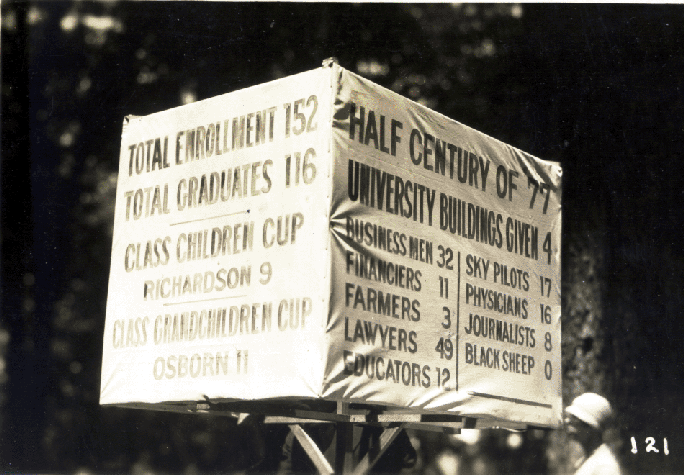
We go on to see, from the class of 1877 (in 1927's P-Rade) a very interesting count of the professions of their members of class. No black sheep! Go Princeton! I wonder how many of today's incoming classes would list their career goals as farmers or sky pilots.
 The Class of 1901 was competitive in 1911's parade they announced they were coming next year by airship.
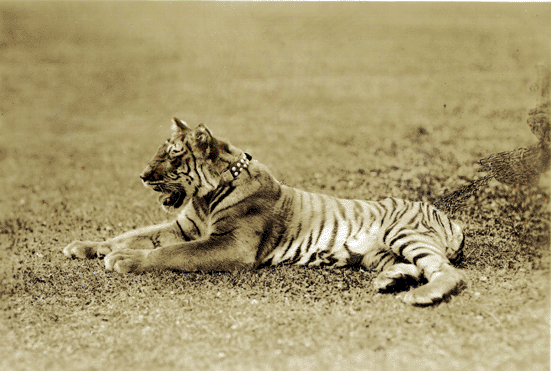
But the class of 1913 tried to beat them out in 1923, they brought a live tiger!
 There are more serious photos of the P-Rades as well in 1983's P-Rade the Class of 1973 wanted to remind their younger counterparts that there was a time when women weren't allowed in Princeton's sphere.
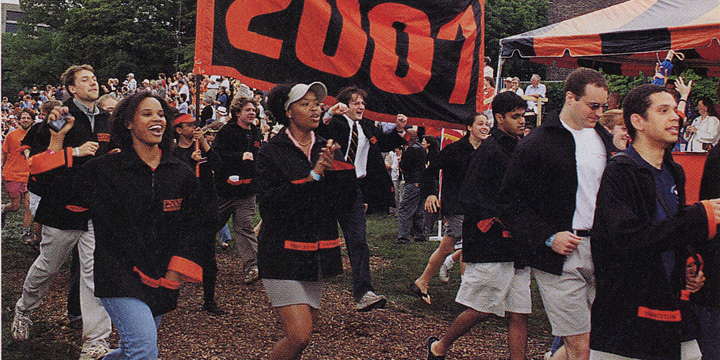
And that brings us to today (image from 2001), the Princetonian Parade today is a little more diverse and perhaps a little less extreme (not to these guys!). However, the spirit and drive behind it stays the same- students, alumni, and families come together to express their class and university pride.
May it continue for a few hundred more years.
Images used with permission of Mudd Library.
Pequod woes
 Oh pequods. Each semester students are made to purchase these collections of texts for their classes. This can be particularly painful if a pequod is required in addition to textbooks, and I have had many-a-class for which the textbook cost has been substantially raised because of this.
When I took ECO 101 last spring, a pequod was prepared for the class, but the materials were also available online, which gives students the option of choosing how to acquire the required readings. And that's the way it should be.
Alas, many classes still do not provide their materials online, requiring students to purchase these books, and the complaints each semester are undoubtedly routine. You can find out more about the scandalous pricing at pequod here.
Tuesday, February 2, 2010
Orange and Apples: UNC
It can be tough to decide where to attend college and although recommendations offer help, they tend to lack clear guidelines. Luckily, Nitin Sekar GS, an ecology student who graduated from UNC- Chapel Hill in 2008 with a degree in Biology and Environmental Science, has rules for students choosing between Princeton and UNC.
I had actually hated the University of North Carolina when I visited. It had been cold and rainy, and the tour guide had admitted that she wasn’t enjoying her time at Chapel Hill. Even the name of the school and its mascot seemed clunky and undistinguished. I had been denied the best scholarships to UNC, and I felt underappreciated. On the other hand, even my admission to an Ivy League school was an honor worthy of my high school efforts. I knew my mother wanted more than anything to tell the proud and wealthy women in the Indian community, “My son is going to Yale.”
Yet in late April 2004, I sent my acceptance forms in to UNC-Chapel Hill. I had decided to be purely logical about this. I was saving my parents $60,000, and I was going to one of the 25 best schools in the country. Most UNC students did love their school. And I knew Chapel Hill was, on average, warmer than New Haven.
Going to UNC ranks among the best decisions I have made in my life. The cynic will point out that I didn’t attend Yale for even a day: so how could I know what I was missing? All I can say is that I know two things: first, my life was full at UNC. I was too busy enjoying my trips to Siberia and South Africa, the late-night Frisbee and soccer games with far superior athletes, the stimulating company of advisers and friends with a broad array of backgrounds, and the thrill of helping launch a million-dollar philanthropic project to wonder what else I would have gotten at a private school. Second, I saved my parents enough to allow them to travel around the world, and for my dad to take a risk and pursue his dream occupation.
I started my Ph.D. in ecology at Princeton last year. Fresh out of undergraduate, I tried to recreate my UNC experience, visiting undergraduate clubs and events. Everything seemed a little quieter than it was at UNC: the arts groups and athletic teams were a little less impressive, the humanitarian activists a little less vociferous, the religious and political proselytizers a little more mellow. But through my interactions with my students, one thing was clear: the academic environment was definitely more competitive. While at UNC the most serious learners form a tightly-knit, intellectually stimulating community as good as any, we didn’t have to contend with as many of each other in the classroom. We would often be separated based on discipline, each competing with a few like ourselves and many others more interested in other less academic life pursuits. This effect should not be exaggerated: the material in my classes was challenging. But I was usually pretty sure that if I tried, I would get the A. That may not have been true for me at Princeton.
Princeton’s other great asset was the acclaim of its faculty. From Peter Singer to Paul Krugman to my own advisers, Andy Dobson and David Wilcove, it seemed as though every person here was the leader of critical field or a vast following. The density of these great minds startled me, and made me wonder if perhaps I would have grown a little faster intellectually if I had met such people earlier in my education. However, many state schools also have phenomenal thinkers, many of whom collaborate with Princeton’s professors, and I somehow doubt I could have grown any faster as an undergraduate. One can often learn more from the third-best person than the best person in a field, for it may be the former who is more intent on educating than publishing.
I offer this formula for deciding whether you should go to Princeton over a cheaper yet similarly high-quality alternative. In addition to being in love with Princeton, at least one of the following should be true for you.
1. Princeton will be less than 20 percent more expensive than your alternative.
2. Your parents or sponsors are so wealthy that they will not miss or need the extra money.
3. You are certain you will be wealthy enough in the future so as to not mind paying back loans, even though you could have become wealthy regardless.
4. You have found a professor at Princeton, a potential life mentor, who is uniquely suited to satisfy your demands as a brilliant or supremely industrious student.
For most of us, the Ivy League is a rather expensive place to find ourselves during our undergraduate years. But I recommend coming here for graduate school, because then, the Ivy League will pay you!
If you're a former Tiger who is now pursuing graduate studies elsewhere or a Princeton grad student who attended undergrad outside the Orange Bubble and would like to contribute a comparison send an email to blog@dailyprincetonian.com.
Schmidt '76 warns of technology's influence
Google CEO and chairman, Eric Schmidt ’76, cautioned that increased use of electronic media may reduce the “deep reading” ability of today’s youth, according to the Agence France-Presse.
Schmidt, who was speaking at the World Economic Forum in Switzerland, explained that using electronic mobile devices has lessened the time people spend reading traditional print media. As a result, people may fail to develop strong reading and comprehension skills. Schmidt noted, however, that video games may enhance strategy and reasoning skills.
Later in his talk, Schmidt addressed security in the internet age. He explained that he feels the inter-connectedness of the internet may reduce personal security.
Google itself has recently dealt with security concerns as several internet attacks from China prompted the company to threaten to withdraw from China. While Google has decided to continue operating in China for the time being, Schmidt told The Washington Post he hoped it would be “on somewhat different terms.”
Still hoping to encourage innovations in technology, Schmidt established the Eric and Wendy Schmidt Transformative Technology Fund at the University last October. Schmidt earned his undergraduate degree at the University in electrical engineering and served as a trustee from 2004 to 2008.
Toilet Terrors, Hygiene Horrors
In the fall of 2008, students returned to campus to find manual soap dispensers replaced by automatic soap dispensers and automatic toilet flushers replaced by manual toilet flushers. These changes, intended to make bathrooms more environmentally friendly have in my personal experience dealt a one-two blow to personal hygiene.
When using a toilet that flushes automatically, I don’t need to touch an icky green handle that everyone else on my floor’s poopy hands also touched. The “green” toilets leave me with the option of jumping or stomping on the handle or going barehanded and trying to wash off all the grossness later. A study by The Daily Princetonian shows that the handle maker’s claims that the handles are coated to protect against germs is an exaggeration at best. When flushers are too high to stomp on or I am feeling uncoordinated, I risk getting all the germs in the middle petri dish in the aforementioned study on my hands.
Flash forward to the soap dispenser. Approaching the soap dispenser, I stick my hand under and – nothing. Maybe the light blinks. I wave my hand in front, around, try waiving one hand while holding the other one under. Still, nothing. Maybe the dispenser makes a dejected noise but doesn’t give me any soap. Based on personal experience, I would say that this happens about 15% of the time. In contrast, manual soap dispensers are pretty reliable. There could be no soap, so you slide the bar left. If you get really desperate, you can always open the dispenser and squeeze some of the soap from the bag on your hand.
This issue may not concern you as much as it concerns me, but it should.
By Mendy Fisch, Executive Editor for Opinion.
Monday, February 1, 2010
In the News: Grade Deflation and Cost Inflation
Yes, apparently Princetonian grade deflation woes have made it to the national stage. The New York Times recently published a feature in its education highlighting the controversy surrounding the University's policy. You can read more about how we grumble about grade deflation here.
The article does a pretty good job of summarizing the arguments surrounding the policy and notes that the policy has reduced the number of A students among us. In fact, it seems as though the average Princeton student is becoming increasingly B+. The average GPA of the graduating class has fallen 0.05 points since 2003 to 3.39 for the Class of 2009.
But what's this? Not all is deflating? Find out more after the jump.
Several days before the grade deflation article was published, The New York Times published a note on inflation and the University's tuition. The rising cost of attending Princeton was covered in greater detail by the 'Prince' .
It seems that the combined cost of undergraduate tuition, room, board, and other fees will be increasing by 3.3% for the coming academic year. The Times notes that this figure "tops inflation", and while that may be, the annual inflation rate is close behind at 2.7% (Dec. 2008 to Dec. 2009).
Interestingly, the Bureau of Labor Statistics also reported that the cost of medical care has increased by 3.4% over the same period. Those of us who have taken Macro may remember that the costs of education and medicine tend to rise at a rate greater than the rate of inflation. This is because these are two 'industries' that can't become anymore efficient.
Orange and Apples: Brown
Princeton Men's Basketball team defeated Brown handily this weekend by 16 points, but off the court how do the two compare? Candas Pinar GS, a student in Near Eastern Studies, who graduated from Brown in 2006 with a degree in Religious Studies, explores the similarities and differences between the two schools.
Pristine courtyards. Enormous library. Picturesque seminar rooms. Lather. Rinse. Repeat. The monotony of the campus tour, a cornerstone of any high school senior’s application process, often leaves students wondering what exactly the difference is between this school and that. While most tours end at the campus gates, the community surrounding a school, I think, is often what gives a school its distinctive “feel.” A comparison of Brown and Princeton, then, should start with a comparison of Providence, R.I., and Princeton, N.J.
For all intents and purposes, Providence, especially the part of the city hosting Brown, is a typical college town. The main drag, Thayer Street, is home to an array of cheap, ethnic restaurants and dumpy dive bars. A mammoth Urban Outfitters is flanked by secondhand and vintage clothing stores. Neighboring Brown is RISD, the Rhode Island School of Design, the creative student population of which inspires the more artistically inclined at Brown.
Princeton, on the other hand, is a bit more high-end than Providence. J.Crew, the headlining clothing store on Nassau Street, serves as the gateway to a collection of luxury retailers. Princeton boasts an impressive variety of restaurants, but many, with the notable exception of Hoagie Haven, are out of reach for those on a student budget. (This wasn’t of much concern to me, as I quickly discovered that on-campus dining at Princeton is a pleasure, not a bother.)
If we move from community to classroom, I’ve been impressed with the student body and the faculty at both Brown and Princeton. The quality of education at both schools is equally phenomenal. While I’ve taken only a handful of classes with undergraduates at Princeton, I can say that there’s more diversity in political persuasions at Princeton than at Brown, and you can see manifestations of this in classroom discussions. What I appreciated most about my academic experience at Brown were the intimate relationships I was able to cultivate with professors as an undergraduate, but since I’m not familiar with the undergraduate education at Princeton, I don’t know if Princeton undergrads have similar opportunities.
Outside the classroom, I’ve noticed one key difference. With the corn fields of New Jersey as its backyard, Princeton spreads out much more than Brown. I do a lot more walking at Princeton than I ever did at Brown. A small campus may be a negative for some, but for me it meant seeing friends and professors at any given time of the day. Essentially everyone has to pass through the Main Green to and from classes, and seeing and being seen on the Green was a staple of daily life at Brown.
Selecting a school that meshes with your personality, your interests and your needs is an incredibly overwhelming task, but don’t let it keep you up at night. Take comfort in the monotony of the college tour. They’re monotonous for a reason: Many of these schools aren’t terribly different from one another, and the differences that do exist are often mere nuances.
If you're a former Tiger who is now pursuing graduate studies elsewhere or a Princeton grad student who was an undergrad outside the Orange Bubble, and if you would like to contribute a comparison to the Oranges and Apples series, please send an e-mail to blog@dailyprincetonian.com.
Lost in the labyrinth
 Labyrinth is a business. Everyone knows this. So I shouldn’t have been surprised when I saw some employees trying to resurrect the spirits of John Jacob Astor, J. P. Morgan, and John D. Rockefeller in a séance, which took place in the alley behind the store. Just kidding. But I did witness a bit of scheming going on in Labyrinth the other day.
I bought a textbook for $144 from the book store, but when I found a better deal (gasp!) I decided to return it. While I was returning the book, a person who seemed like a manager walked behind the register to talk with some of the employees.
Mr. Manager Man was telling the cashiers that “we don’t want to encourage students to return their books” and that instead of explaining the store’s return policy they should just say “the store’s policy is on the bottom of your receipt. Make sure you keep it.”
When I initially bought that overpriced hunk of paper, the cashier was nice and explained that if I returned books by February 12, I would get all my money back and after that date I would be issued store credit.
But NOW, Labyrinth is showing its true colors! They might pretend to be all cool by hiring hippies/hipsters/I’m-too-coolers and constantly mentioning that they’re an independent bookseller to amp their street cred, but I know what’s what. Beneath their carbon-neutral program, are the souls of robber barons past!
Vive la résistance! ¡Viva la revolución!
Saturday, January 30, 2010
'To Regular Users of This Restroom'
 I am positive that 99.9 percent of the reason Princeton made it to third place on GQ’s douchiest colleges’ list was because of Marquand. Instead of announcing closing time, the staffers decided that the most effective and passive-aggressive alternative was turn off all the lights while the patrons were still working. I once heard a professor say that he wanted to take his class to see some artwork, but didn’t feel like dealing with the “White Glove Brigade.”
But when I found this little gem taped to the wall of the women’s bathroom in the basement of Marquand, I felt like I had discovered hot Frist pizza in the water bottle cabinet. It’s douchbaggery in print!
They could have just posted a sign that said, “Please keep the bathroom clean,” but no, Marquand has to do things with style. A letter, complete with target audience, was the way to go. The tone also had to be reminiscent of the matron of a girl’s finishing school in Victorian England.
I felt the need to rebel after reading this. I left Marquand to get a snack, and when I came back, I smuggled in two cookies by hiding them in my coat pocket. The bag checkers might have won the battle, but I know I won the war.


 Posts
Posts

